How Praktika went from $0 to $50M+ ARR
The setup, creators, formats, hooks, markets and costs behind 60M views a month, plus how Praktika’s strategy compares with six other language apps.
Praktika is an AI language tutor. You speak out loud to an animated coach and it corrects you as you go. Co-founder Adam Turaev puts the business at ~$50M ARR, ~500K paying subscribers, a team of 40+, and profitable.
All data sources from ugcpulse - our ugc intelligence platform
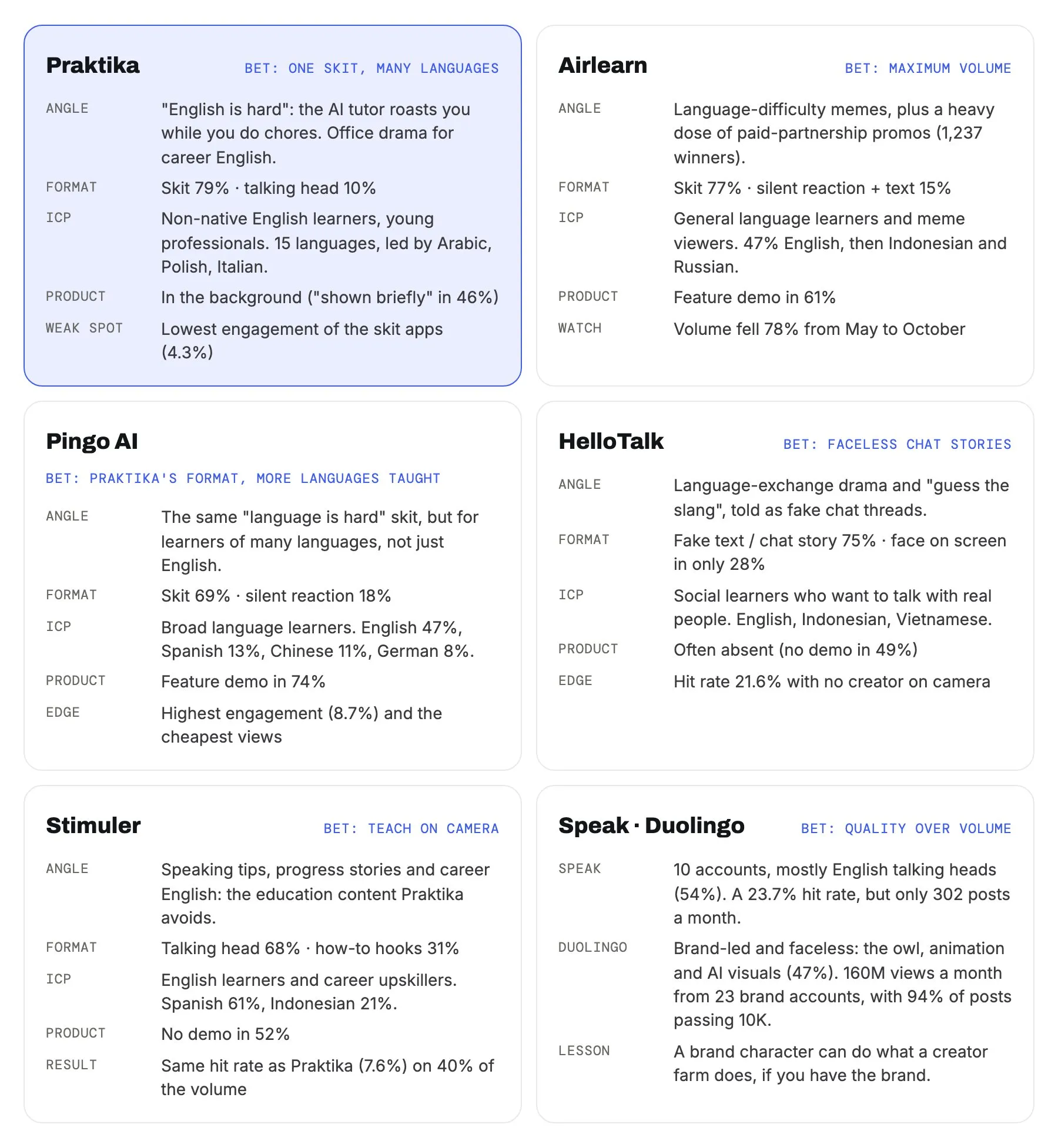
This covers how the program grew, who it targets, the formats and hooks that win, how winners get copied across languages, what it costs, and how it compares with Airlearn, Pingo AI, HelloTalk, Stimuler, Speak and Duolingo.
Summary
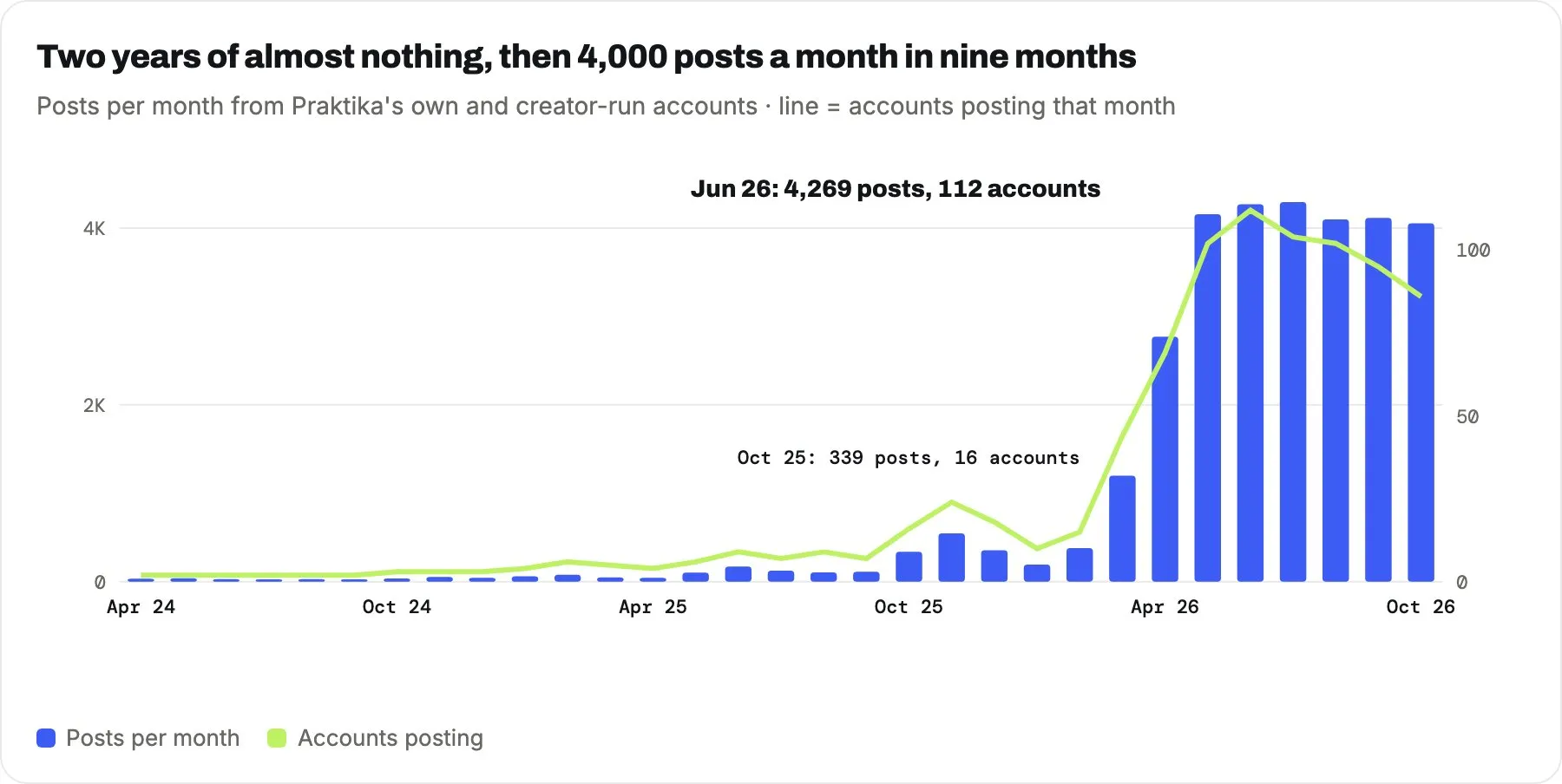
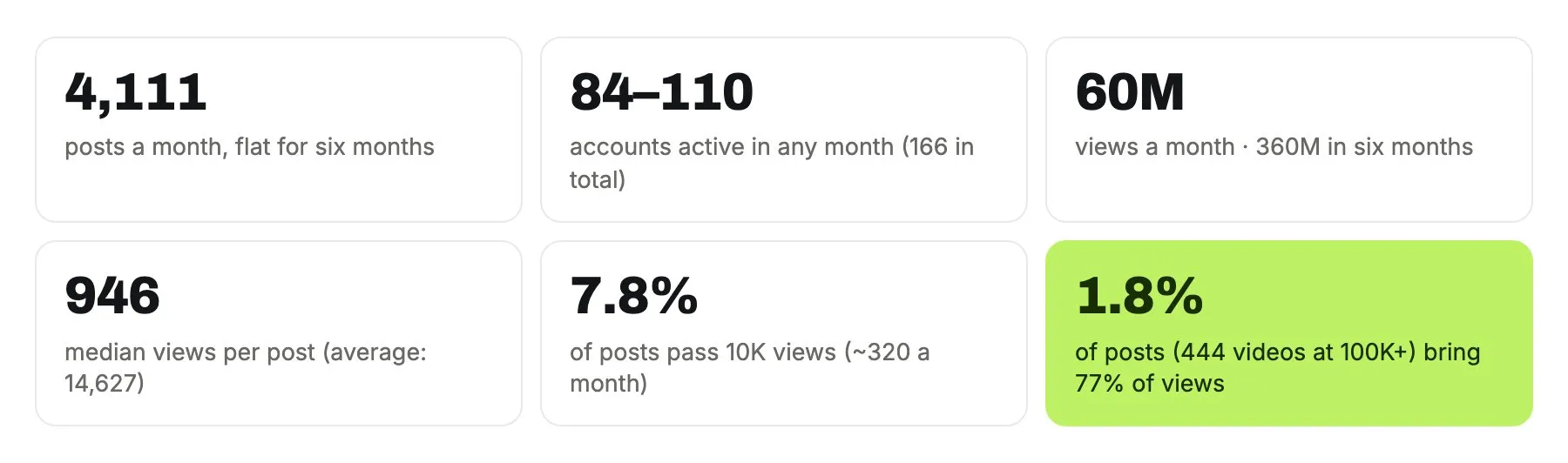
- High-volume UGC accounts: 166, with 84–112 posting in any month, ~4,100 posts a month in total
- Total views: 360M in six months (~60M a month)
- Average / median views: 14,627 / 946 per post
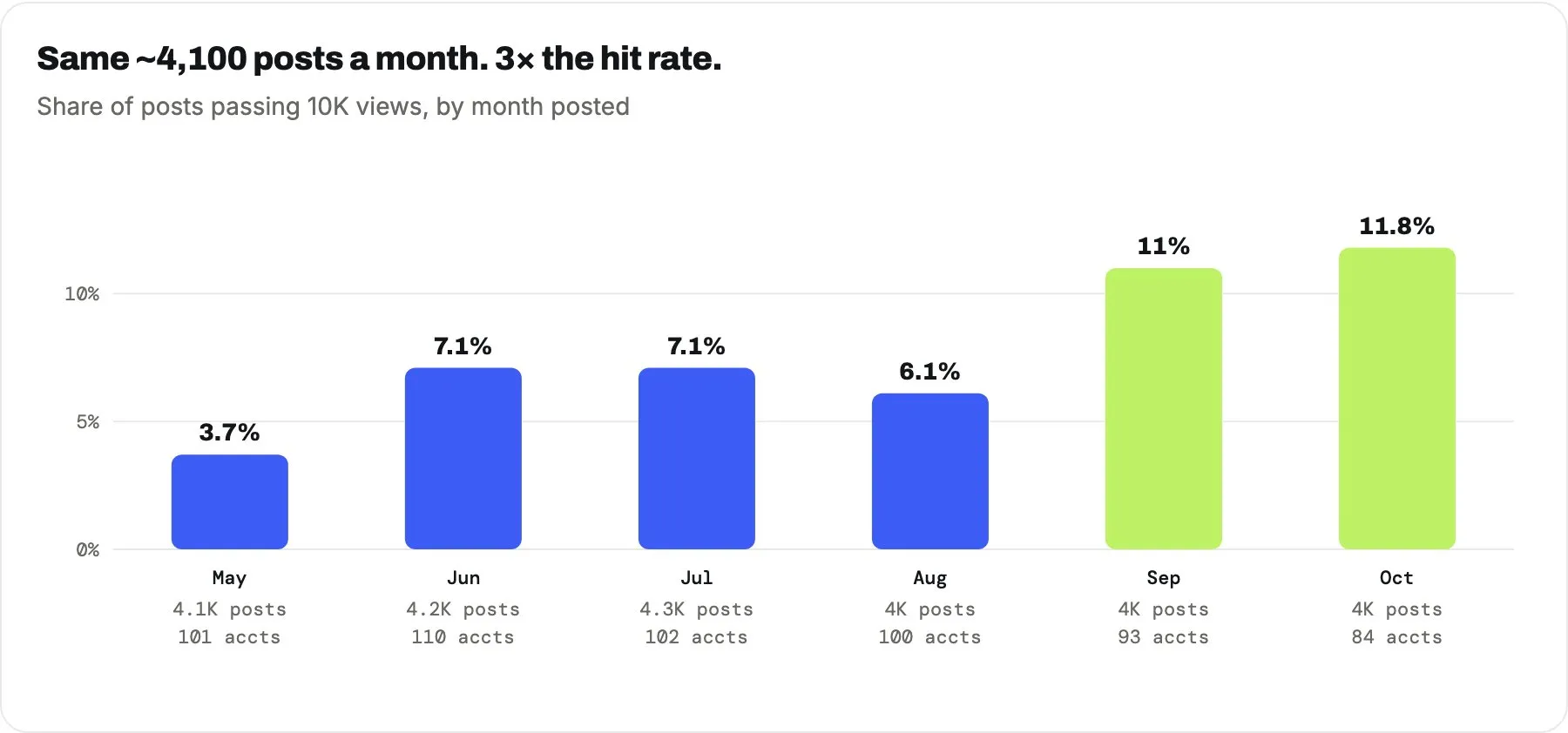
- 10K+ hit rate: 3.7% → 11.8% in six months, with the same number of posts
- Best format: the chore + AI tutor skit (1,001 winners, 177M views). Video-call skits get the most views per winner (63K median).
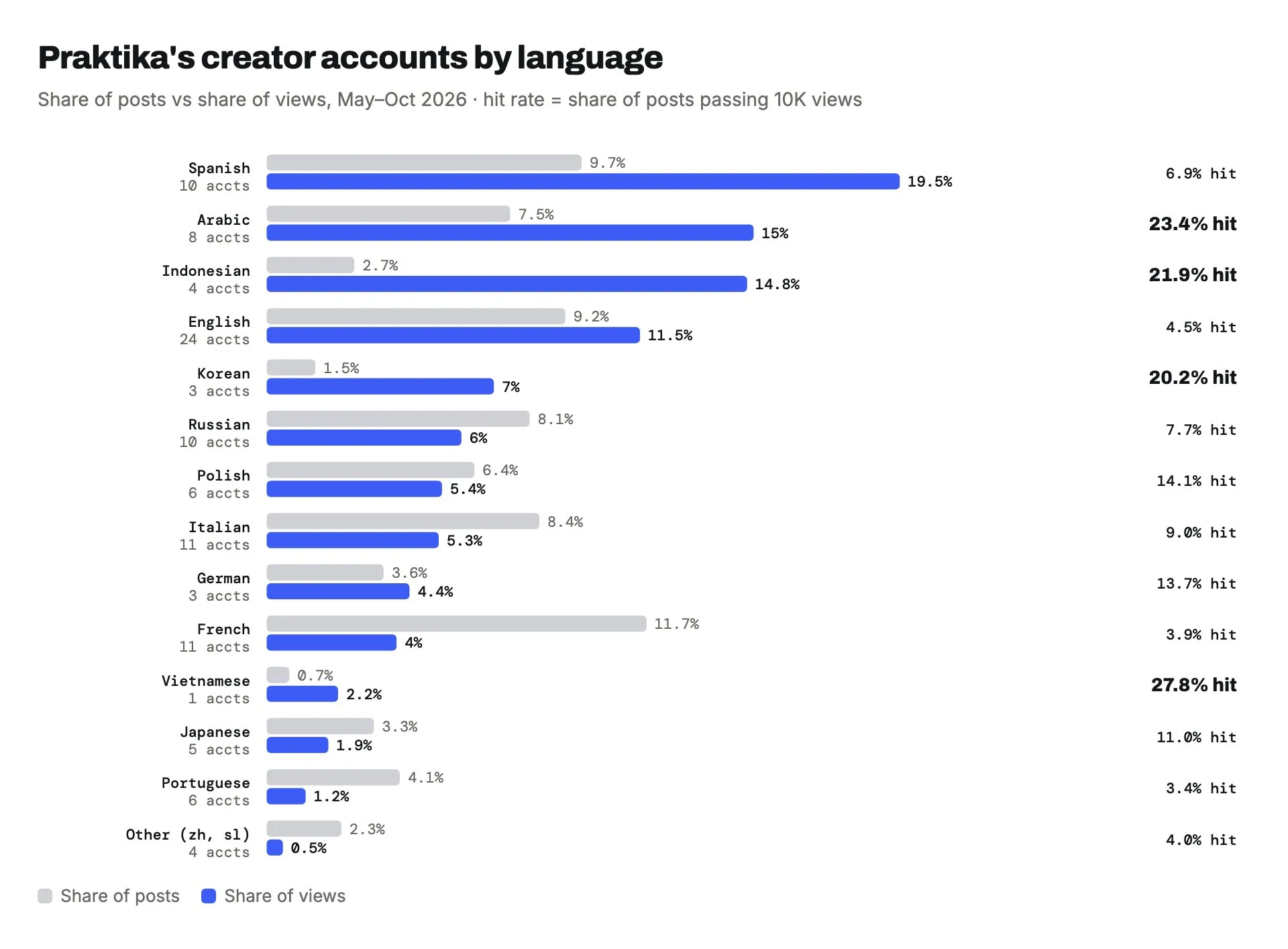
- Languages targeted: 15. Top by views: Spanish (19.5%), Arabic (15%), Indonesian (14.8%), English (11.5%)
- Best video: “I hate Spanish.” by @nesly.praktika on Instagram, 10.4M views
- Cost: ~$100K/mo, CPM -$1-$1.5
Praktika’s growth timeline
- Build the tutor (2021–2023). Started prototyping an AI English tutor in 2021 using avatars and scripted dialogues. Launched in mid-2023.
- Pick the right market. Chose Brazil, where English proficiency was low but English speakers earned significantly more. Positioned the product around better jobs, not just learning English.
- Find a viral format. Cold-DMed a Brazilian creator discovered on Modash. One video generated ~30M views across platforms, taking ARR from ~$1M to $10–12M in a month.
- Scale creator partnerships (2024–2025). Kept owned accounts lean (2–9 accounts, under 200 posts/month), focusing on winning formats, creators and paid amplification.
- Built a High Volume UGC Engine (Oct 2025–Jun 2026). Scaled to 112 accounts and 4,269 monthly posts, adding 126 creator accounts in just four months.
- Optimise, not just scale (Jun–Oct 2026). Maintained ~4,100 monthly posts while tripling the hit rate.
How Praktika broke into a crowded market
Language learning is one of the most crowded categories in consumer apps. Duolingo owns it on social: its own brand accounts pull ~160M views a month with the owl. Babbel and Busuu have been around for over a decade. Since 2023, dozens of AI tutor apps have launched, including Speak, Pingo AI, Airlearn, Voca AI, Bunpo, Stimuler, LingoTok and Fluently. Praktika and the six apps compared in this article alone post ~36,000 videos a month.
Praktika still got to $50M+ ARR. Six choices made the difference.
- A sharper promise. Focused on spoken English for career growth, not learning every language.
- Local-first distribution. Used data to pick markets like Brazil and created content in local languages. Just 9% of winning videos are in English.
- A visible product. Its animated AI tutor became a recognisable character and made every skit a product demo.
- Show, don’t tell. Content demonstrated the core experience: speaking, making mistakes and getting corrected.
- Prove before scaling. Found a winning creator format before building a 100+ creator network.
- Optimise for hits. Held output at ~4,100 posts/month while tripling the share crossing 10K views.
How app UGC works: high-volume, creator and ads
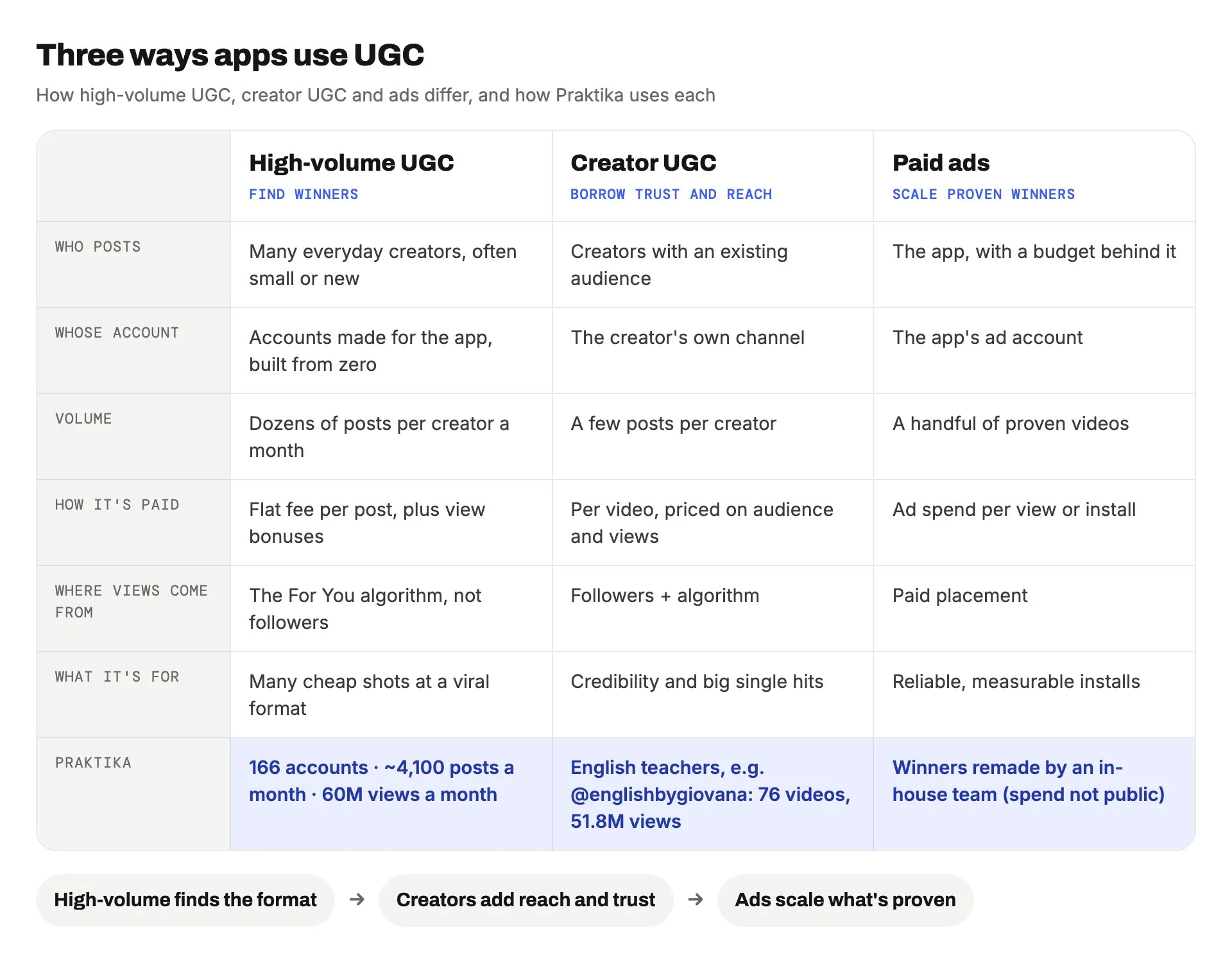
Most consumer apps that grow on TikTok and Instagram use some mix of three models. They get lumped together as “UGC”, but they work very differently, and Praktika uses all three.
1. High-volume UGC
The app recruits lots of everyday creators, usually small or brand-new, and each one runs an account made specifically for the app. These accounts start with zero followers. Views come from the For You algorithm, which shows videos to people who don’t follow the account.
- Volume: dozens of posts per creator per month.
- Pay: a flat fee per post, often with a bonus when a video hits a view target.
- Why do it: every post is a cheap shot at going viral. Most flop, a few blow up, and the app learns which formats work.
2. Creator UGC (influencers)
The app pays creators who already have an audience to feature it on their own channels.
- Volume: a few posts per creator.
- Pay: per video, priced on audience size and expected views.
- Why do it: borrowed trust and big individual hits. The audience already likes the creator.
3. Paid ads
The app puts ad budget behind videos, usually ones that already worked organically, so they reach a guaranteed audience.
- Volume: a handful of proven videos.
- Pay: ad spend per view or install.
- Why do it: reliable, measurable installs at scale.
The three work as a loop: high-volume UGC finds the winning format, creators add reach and trust, and ads scale what’s proven.
How Praktika uses each
- High-volume UGC: 166 creator-run accounts posting ~4,100 videos and getting ~60M views a month. 37 have “praktika” in the handle. This is the core of the program and the focus of this article.
- Creator UGC: established English teachers on their own channels. @englishbygiovana has 76 Praktika videos with 51.8M views, @jayfujiwara 12 videos with 34.8M, @carolinakowanz 12 videos with 9.7M.
- Paid ads: per Turaev, winning organic formats are remade for paid by a separate in-house team.
Praktika’s high-volume UGC setup
- ~100 creators in the program, per Turaev. In the data, 84–112 accounts posted in any given month, 166 over six months.
- ~42 posts per account per month on average across the six months. In October the median active account posted 54 times, almost twice a day.
- ~4,100 posts and ~60M views a month, 86% on TikTok and 14% on Instagram.
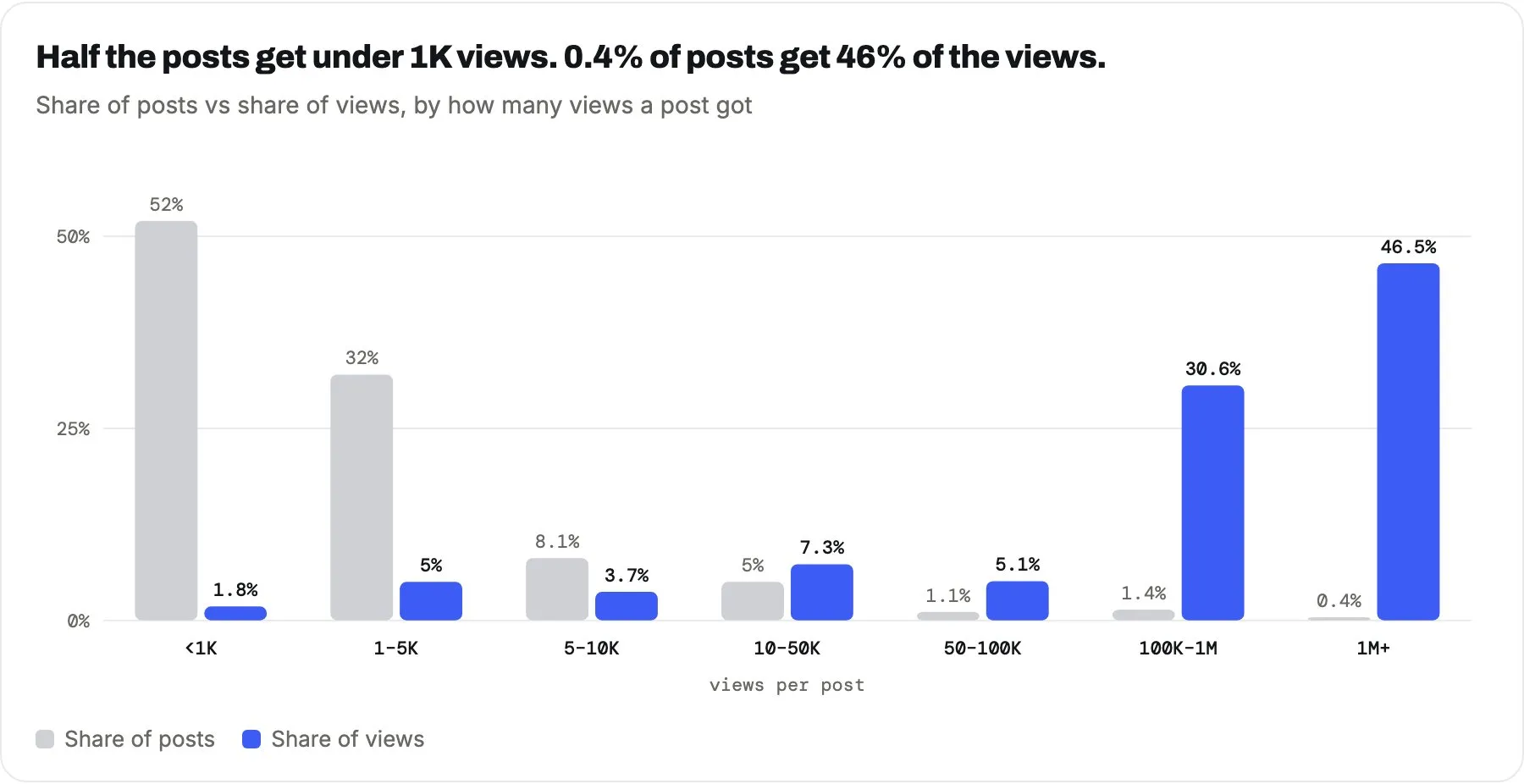
- 946 median views per post, 14,627 average. 7.8% of posts pass 10K views.
- Country-specific accounts. Each account sticks to one language (93% of its winners), so every account is effectively a local channel for one market. 15 languages run in parallel.
- Creator coaches, often ex-creators, each manage 20–30 creators: they hand out briefs, track what works and push winning formats across the team.
Split by language market
Praktika’s target customers (ICPs)
Praktika’s content is built backwards from its pitch: speak English well enough to get the better job. Reading the content data alongside the interview, three customer groups stand out.
1. The frozen speaker. An 18–30-year-old who learned English at school, understands it, and freezes when they have to say it out loud. They want practice without being judged. 65% of winning videos are aimed at English learners, and the top theme is jokes about how hard English is.
2. The career climber. A young professional whose next job, interview or promotion depends on English. This is the group with the strongest reason to pay. Job-interview and work-call skits get the highest median views of any template (63K).
3. Non-English-speaking markets. Arabic, Polish, Italian, Spanish, Indonesian, German, French and Russian speakers, plus Korea and Japan, each reached in their own language. The program runs in 15 languages. Arabic leads with 21% of winners; English-language posts are only 9%.
How views are distributed
Hit rate over time (10K+ videos over time)
Winning content: formats and templates
79% of Praktika’s winning videos are skits. Only 10% are someone teaching to camera. Most of the skits follow one recipe, and the #1 video shows it clearly.
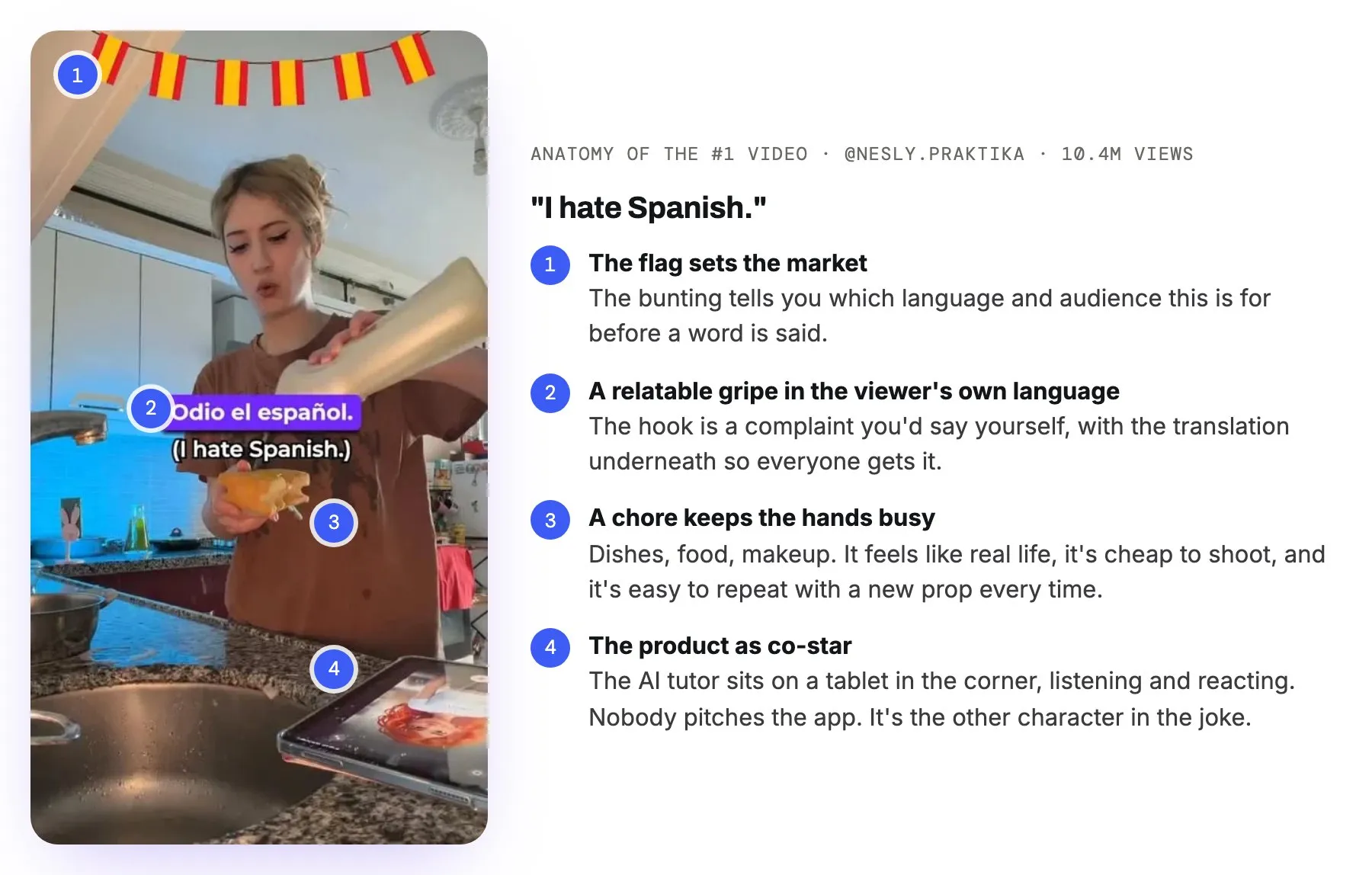
Template A: chore + AI tutor skit
The creator washes dishes, eats, cuts fruit or brushes their teeth while practising English with the AI. They get it wrong, the tutor loses patience, and the creator argues back. 1,001 winners on 82 accounts in 20 languages, with 177M views.
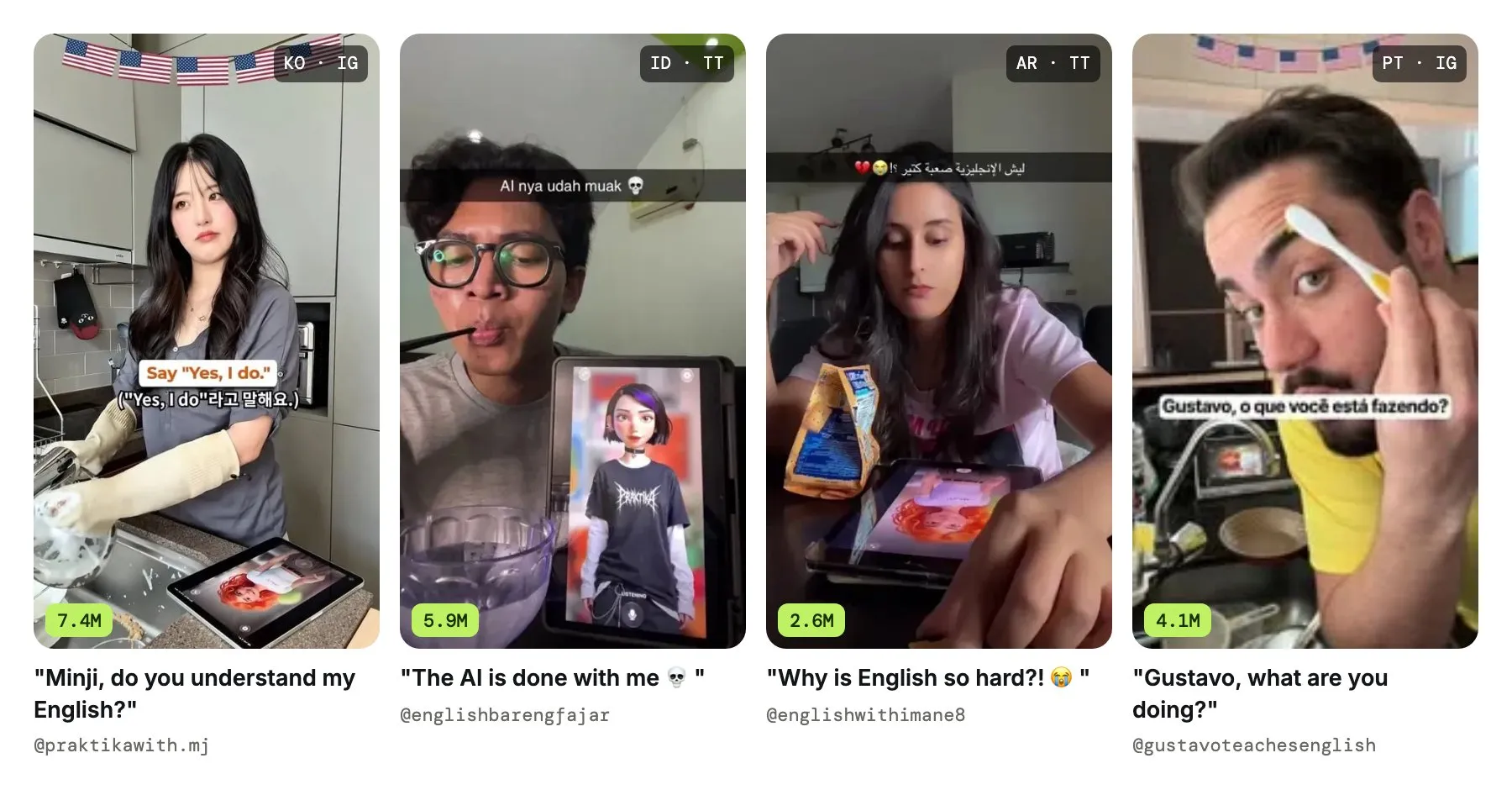
Template B: video-call / job-interview skit
A Google Meet or Zoom grid where something goes wrong: the boss’s kid crashes the meeting, a job applicant turns out to be the ex, the recruiter is a nightmare. It speaks directly to the career climber. Only 141 winners, but a 63K median, double Template A’s.
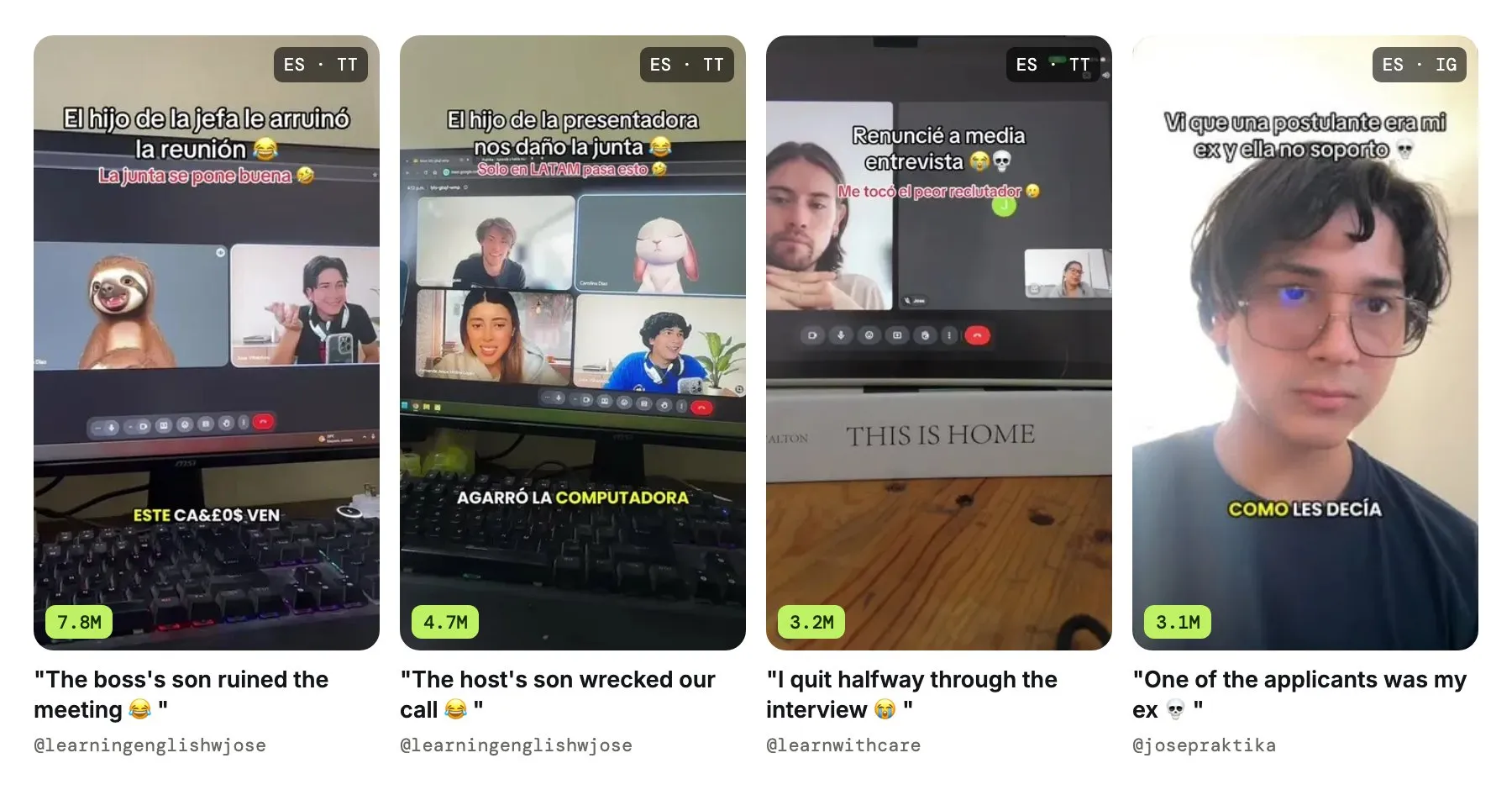
Template A drives volume; Template B gets the most views per winner.
Other patterns in the winners
- Hooks: 57% open with a relatable call-out (“English is so hard 😭”), 28% with a curiosity gap (“I had to record this one”).
- Length: posts over 60 seconds pass 10K views 11.8% of the time; posts under 10 seconds, 2.5%.
- Production: 97% show the creator’s face with no voiceover. Shot on a phone, at home.
- Product placement: in 46% of winners the app is only shown briefly, in the background of the scene. It’s not a demo.
Why the content works
1. It starts from a shared pain. “English is hard” is true for hundreds of millions of people. In the viewer’s own language it reads like a friend complaining, not an ad.
2. The product is part of the joke. The tutor listens, corrects and reacts, which is exactly what the app does. Viewers see the product working without being sold to.
3. It turns the real fear into comedy. The frozen speaker’s biggest fear is being judged. In the skit the AI is judgmental for laughs, which works because the real app isn’t.
4. It’s easy to copy. A kitchen, a snack and a tablet. Any creator in any country can shoot a new version tomorrow, and the algorithm treats each one as a new video.
5. It suits the For You page. Comedy holds attention to the end, and longer skits hit more often. Lessons get skipped.
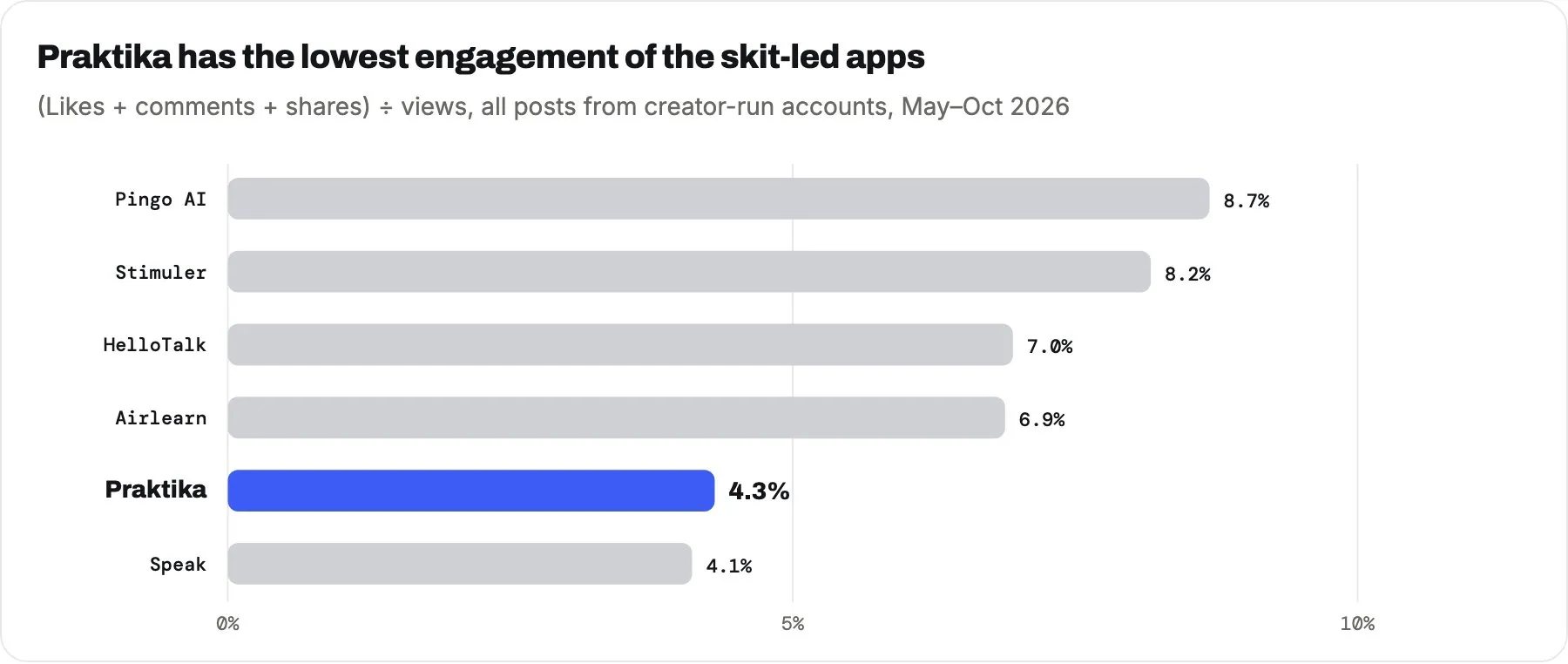
But, Praktika has lowest engagement in the category
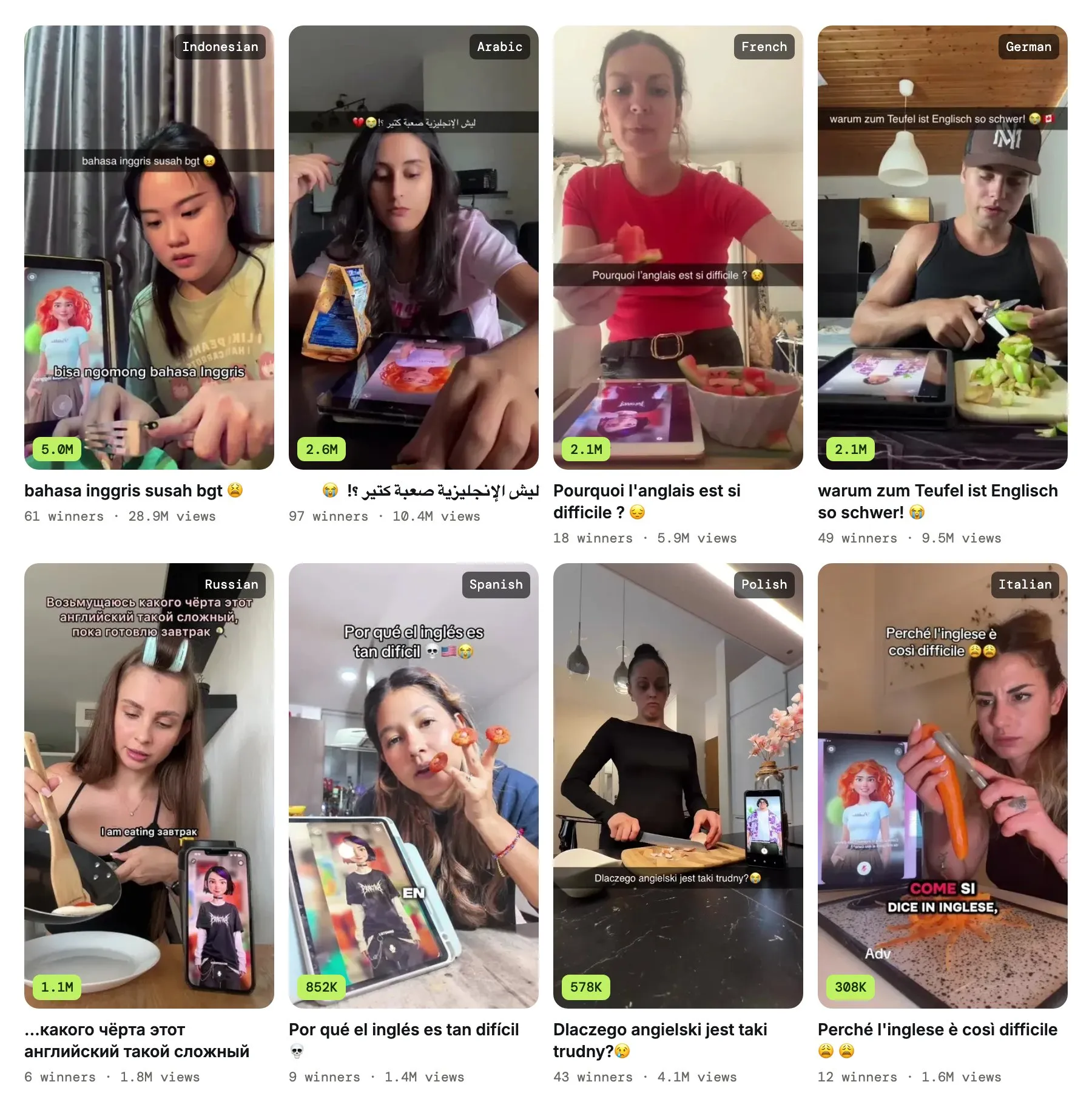
How Praktika replicates winning videos
The hook “Why is English so hard?” has been posted in 13 languages by Praktika’s creators. It produced 321 winners on 40 accounts and 66.3M views, 18% of the program’s total views.
Praktika’s UGC playbook, step by step
- One account, one language. Accounts post 93% of their winners in a single language. Each one works as a local channel.
- Hire rising creators, not famous ones. Use Modash and Sideshift, filtering for low followers and high recent views.
- One coach for every 20–30 creators. Coaches are often former creators. About 100 creators in total, paid a fixed fee plus view bonuses.
- Post every day. In October the median active account posted 54 times, almost twice a day.
- Copy winners across creators, and let the best experiment. Translate proven skits into every language, and give top creators room to find the next one. Turaev: “don’t tell influencers how to do their job.”
- Cut quickly and keep the best. Half of the summer’s accounts were gone by October. Some top creators get hired.
What Praktika avoids
Educational content. Praktika positions itself against “edutainment”, and the content follows. Only 10% of winners are a person teaching to camera, and they get about half the views of a skit (median 19K vs 37K).
A rude tutor in the app. Turaev calls putting the “unhinged” avatar persona into the product their biggest failed experiment: users disliked it. The tutor on TikTok can roast you; the one in the app coaches you. Marketing gets creative freedom, and the product keeps its guardrails.
Estimated cost of the program
Praktika doesn’t publish creator rates. Our estimate is ~$100K a month, all-in:
- Posts: ~4,100 a month at ~$20 each = ~$82K
- On top: view bonuses for winning videos and the creator coaches
- Per 1,000 views: ~$1.70
- Per year: ~$1.2M, about 2.4% of ~$50M ARR

Competitor strategies: angles, formats, ICPs
Looking for the complete language learning UGC category breakdown?
Drop a comment below and I will DM you!
If you need help with your UGC motion (high volume or creator), from finding creators to knowing what to post that drives views and conversions, to running these programs, check out ugcpulse.app and DM me :))
And if you’re looking for an AI UGC solution, check out www.fastpulse.app.